Gas Shortage Is Not Just a Supply Problem, but a Failure of Governance

Editorial
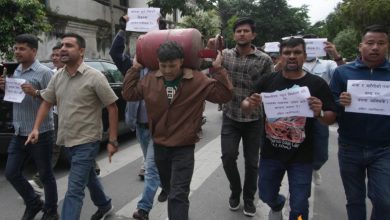
The shortage of cooking gas in the Kathmandu Valley is no longer a routine market problem. Ordinary consumers are waiting for hours only to return home with empty cylinders. Students are carrying empty cylinders to Singha Durbar in protest. Even parliament members from the ruling side are publicly asking what the government is doing. These scenes reveal a deeper problem: Nepal’s energy security and essential supply system remain so fragile that disruption along a major transport route can quickly turn into a public crisis.
The Bhotekoshi disaster and damage to sections of the Prithvi Highway have disrupted regular supply routes into Kathmandu. Large gas tankers have faced difficulties reaching the Valley, while the government has tried to reroute supplies through alternative corridors and bottling arrangements outside Kathmandu. But the shortage did not begin only after the disaster. Consumers had already been reporting difficulty finding cylinders. The government therefore cannot attribute the entire crisis to floods and road disruption.
The present situation exposes structural weaknesses in Nepal’s supply system. Dozens of private gas companies operate in the country, but the Nepal Oil Corporation does not operate its own LPG bottling plant. Public control over import, storage, bottling, transport and distribution remains limited. The state regulates the market, but when a crisis strikes it has insufficient direct capacity to intervene. For an essential source of household energy to depend almost entirely on a private distribution system raises a broader question of national energy security.
Transparency is another serious concern. The public has no real-time system showing how many cylinders were filled, where they were sent, which distributors received them and how many actually reached consumers. If thousands of cylinders are said to have entered the market while households continue searching from shop to shop, then the problem is not only supply. The government must identify where the distribution chain is breaking down.
Shortages also create opportunities for hoarding, black marketing and preferential distribution. If well-connected consumers can obtain gas while ordinary citizens stand in line for hours, the issue becomes more than market inefficiency. It becomes a question of public trust in the state. The government cannot simply blame private suppliers, and suppliers cannot continue blaming damaged roads. Citizens need gas, not competing excuses.
As an immediate measure, the government should publish daily figures on LPG imports, bottling, transport and distribution. The number of cylinders released by each company and delivered to each distributor should be digitally traceable. Hoarding and black marketing should face strict action. Consumers also need a reliable system showing where and when gas is available.
But short-term distribution management is not enough. The crisis has shown the danger of allowing a major urban centre like Kathmandu to depend heavily on a limited number of transport corridors. Nepal needs alternative supply routes, regional storage facilities and strategic reserves for essential fuels. There should be national standards defining how long the country can maintain supplies of petroleum products, medicines, food and other critical goods during a major disaster.
Nepal must also reduce excessive dependence on imported LPG for household cooking. It is a contradiction that a country with growing electricity generation still leaves urban households dependent on imported gas. Reliable power supply, affordable tariffs, safe electric cooking appliances and stronger household electrical infrastructure could gradually reduce pressure on LPG. This would not only improve consumer convenience but also reduce imports and strengthen energy self-reliance.
Natural disasters can damage roads. Landslides can interrupt transport. But when one major route is blocked and the kitchens of hundreds of thousands of households immediately come under pressure, the problem is no longer purely natural. It reflects inadequate preparedness.
The government’s performance should not be judged only by how many gas cylinders it manages to distribute during the current crisis. The real test is whether it was prepared before the disruption, whether it operates transparently during the crisis, and whether it uses the experience to reform the system for the future.
Today’s gas shortage has created inconvenience in Kathmandu. If the state fails to learn from it, a larger disaster tomorrow could paralyse the country’s entire essential supply network. The immediate challenge is therefore not merely to shorten the queues for gas. It is to redesign Nepal’s system of essential supply management and energy security.