US Military Personnel Adjust Red Carpet Ahead of Xi Jinping’s Arrival: A Moment of Diplomatic Protocol Draws Global Attention

Dragon Media News Desk
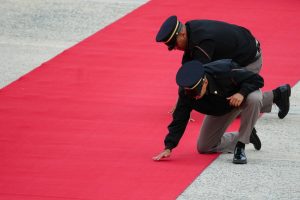
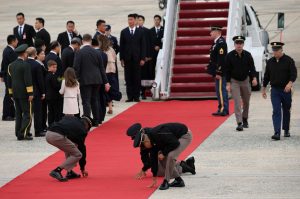
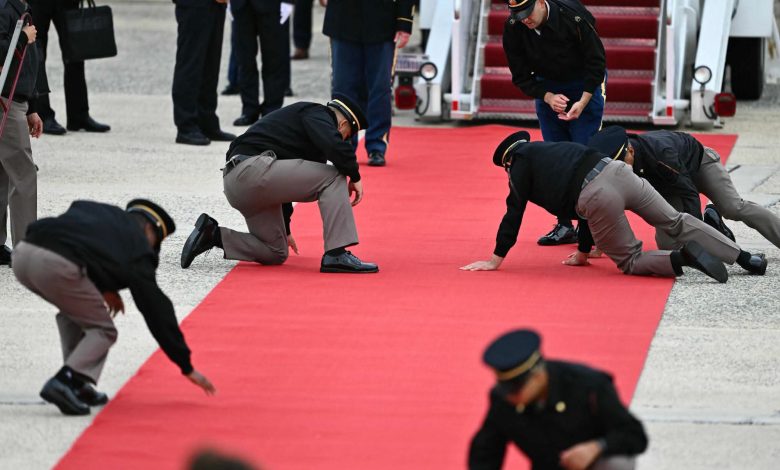
A video showing uniformed US military personnel making final adjustments to a red carpet ahead of Chinese President Xi Jinping’s arrival in the United States has attracted widespread attention online. The footage was recorded at Joint Base Andrews, near Washington, where preparations were underway to welcome the Chinese leader on September 23. The occasion formed part of a high-level diplomatic engagement between China and the United States, with US President Donald Trump personally receiving his Chinese counterpart at the airbase.
According to the South China Morning Post, the approximately 12-second video shows uniformed US military personnel kneeling to straighten and smooth sections of a red carpet measuring about 30 metres in length before President Xi descended from his aircraft. Members of the Chinese delegation could be seen observing the final preparations from the aircraft doorway. Although the footage prompted differing reactions on social media, the activity itself was part of the formal arrangements for a state-level welcome.
The use of a red carpet to receive a visiting head of state is an established practice in international diplomatic protocol. It expresses formal respect not only for the visiting leader but also for the country that the leader represents. Adjusting the carpet should therefore be understood as part of the responsibilities assigned to personnel conducting the reception ceremony, rather than as an indication of political submission or military subordination.
The broader diplomatic significance of the occasion extends beyond the images that circulated online. President Trump’s decision to personally welcome President Xi at the airbase gave the arrival particular prominence. Trump and First Lady Melania Trump received President Xi and his wife, Peng Liyuan, near the aircraft steps. American children presented flowers to the Chinese first couple, while an honour guard stood along the red carpet.
The reception also featured the national anthems of China and the United States, a 21-gun salute and a military flypast involving two B-1 bombers, six F-16 fighter jets and six F-22 fighter jets. The scale of the ceremonial arrangements reflected the importance the US administration attached to the visit.
President Xi’s visit was scheduled for September 23 to 25. China’s Ministry of Foreign Affairs presented the visit as an opportunity to strengthen dialogue, manage differences and expand cooperation between the two countries. Trade, technology, artificial intelligence, critical minerals and international developments were among the subjects expected to feature in discussions.
The reception took place against a backdrop of continuing economic and technological competition between China and the United States. In this context, the decision to maintain direct engagement at the highest political level can be understood as a signal that both governments recognise the importance of managing their relationship through dialogue.
Relations between the world’s two largest economies have consequences extending far beyond their bilateral agenda. Trade, supply chains, financial markets and international security are all influenced by the direction of China-US relations. High-level diplomatic contact therefore carries significance for the wider international community.
China has consistently identified mutual respect, peaceful coexistence and mutually beneficial cooperation as guiding principles of its stated approach to relations with the United States. President Xi has emphasised the importance of both countries working in the same direction, making cooperation a central feature of their relationship, keeping competition within appropriate bounds and managing differences through sustained engagement.
For the United States, managing relations with China is also important from economic and strategic perspectives. Despite disagreements over trade, technology restrictions and security issues, direct dialogue allows both sides to communicate their priorities and assess possible areas of cooperation. Such visits cannot be expected to resolve every dispute immediately, but they can help reduce misunderstanding and maintain continuity in diplomatic communication.
The contrasting reactions to the red-carpet video also illustrate how diplomatic ceremonies can become subjects of domestic political debate. Some social media users interpreted the preparations as an expression of exceptional respect, while others questioned the US administration’s approach towards China. A balanced assessment, however, requires a distinction between the symbolism of a reception ceremony and the substantive outcomes of the diplomatic engagement that follows.
The preparations for President Xi’s arrival were a visible expression of the formal respect extended by the US government to the Chinese head of state. Their longer-term significance will depend on whether the subsequent discussions produce progress in economic relations, strategic communication and the management of differences.
At a time of considerable global uncertainty, sustained contact and practical cooperation between China and the United States remain important not only for the people of both countries, but also for international stability and development.