A Tibetan Director’s Lens Brings Lhasa’s Youth to the Screen

Dragon Media News Desk
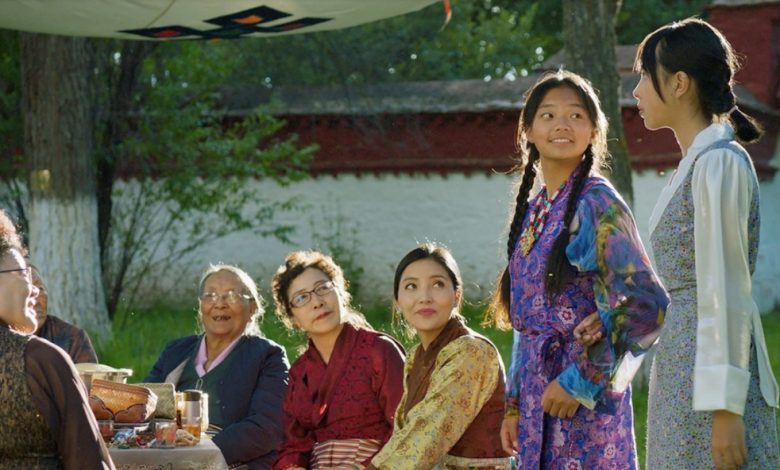
If Kangdrun had to choose a season that defines her childhood, it would be summer. For the 31-year-old Tibetan director, who was born and raised in Lhasa, summer means long school holidays and the traditional Shoton Festival. It also means linka, a cherished local tradition of gathering outdoors for picnics, songs, dances and laughter.
Kangdrun’s first feature film, Linka Linka, opened in cinemas in mid-October. Filmed entirely in Tibetan, the 100-minute movie follows a linka gathering on a summer night in Lhasa and tells three stories tracing the growth of its central character, Sangye.
“I deeply love my hometown. Bringing the Lhasa dialect and modern life to the screen is a natural and sincere wish for me as a native,” Kangdrun said.
The production team filmed the young actress in four stages between 2020 and 2024, documenting her journey from childhood into adolescence. The film received support from a regional literary and arts funding programme.
Linka Linka has also reached audiences beyond Lhasa. It has received awards or nominations in Tokyo, Hong Kong, Sochi and Buenos Aires. At the 50th Hong Kong International Film Festival, it won the Firebird Award and the FIPRESCI Prize. The film has also been selected for festivals in Shanghai, Udine, Barcelona and Vancouver.
Local audiences have described the film as “very Lhasa”—the effect Kangdrun sought as she set out to portray the city and its young people as they are.
“In Lhasa, young people are just as comfortable talking about their childhood in Tibetan as they are planning their future in Mandarin. They go wherever opportunities take them to study, then return in summer to spread mats on the grass and gather for a linka,” she said.
Like Sangye, Kangdrun left her hometown to study. She earned a master’s degree in film production at the Communication University of China in Beijing. While at university, she began filming NAMCHAK, a veteran rock band from Xizang. During academic breaks, she regularly returned to Lhasa to shoot and produce short films.
Many of Kangdrun’s peers, she said, have studied away from home and grown up amid diverse cultural influences. Those experiences have helped them view the plateau more objectively.
“Culture flows, and it evolves as it moves,” she said. “What we young people do today is quietly reshaping this city.”
The Tibetan language is widely used in publishing, media and daily life in Xizang. According to a white paper published last year, more than 15,000 hours of radio programmes, over 80 films and 7,300 hours of television programmes are translated or dubbed to and from minority languages each year.
Kangdrun is now completing another project set in Lhasa. Orlo in the House focuses on a Tibetan person who works at a sweet tea house in the city.
“Filming has wrapped, and post-production is under way,” she said.