Planned Role Claimed in Turning Gen-Z Movement Violent

Kathmandu — Even nine months after the Gen-Z movement, questions remain at the center of political and public debate over how the movement suddenly turned violent and destructive. Meanwhile, public accounts citing a confidential report of the National Investigation Department have claimed that prior preparations by some activists, groups and social media influencers played a role in making the movement violent.
According to the report, the violence was not merely the result of spontaneous anger but the effect of planned activities. It states that after the student movement in Bangladesh in July and August 2024, some activists and groups in Nepal became active with the idea of organizing a similar movement and creating an environment for regime change.
The report claims that Hemraj Thapa, Dr. Nicholas Bhusal, Som Sharma, Bablu Gupta and others had been working since Saun–Bhadau of 2081 BS to organize youths and increase public dissatisfaction with the then government. It says anti-government sentiment was built around issues of corruption and good governance.
According to the report, a meeting was held on Bhadau 22, 2081 BS at Hardik Hotel in Bagbazar, attended by Bablu Gupta of the Hundred Plus Group, senior advocate Balkrishna Neupane, advocate Swagat Nepal and others. The report claims that the meeting concluded that the government had failed to control corruption and ensure good governance, and that major leaders should be chased away as in Bangladesh.
However, senior advocate Neupane has said that although he often attends various programs, he was not involved in any such decision-making process. He has claimed that he may have spoken against corruption and in favor of good governance, but was not part of any violent decision-making process.
The report claims that various activists, groups operating in the name of civil society, pro-monarchy figures, social media influencers and some political groups had direct or indirect roles in the preparations for the Gen-Z movement. The details reportedly mention the names of former chief justice Sushila Karki, Hami Nepal founder Sudan Gurung, Lauro Abhiyan’s Anantaraj Ghimire, Rama Singh, Keshar Bahadur Bista, Kamal Thapa, Durga Prasai, Victor Poudel, Asim Man Singh Basnyat and others.
The report also states that Nicholas Bhusal’s group mobilized youths under the names of “Global Youth Parliament” and “National Youth Parliament.” It claims that anti-government activities were encouraged in Kathmandu Valley and various districts under the slogan of 165 youth MPs in 165 constituencies.
A study report by the National Human Rights Commission also stated that during the Gen-Z movement, various individuals and activists were found to have instructed people to use children as human shields, attack security personnel and carry out violent activities. According to NHRC member Lily Thapa, several videos examined during the study showed senior figures and activists making remarks that incited violent activities.
The report further claims that AI-generated misleading photos and videos showing public structures such as the Parliament building and Singha Durbar on fire were circulated on social media even before the movement began. This has been described as part of a strategy to present the movement as peaceful on one hand while planning to make it destructive on the other.
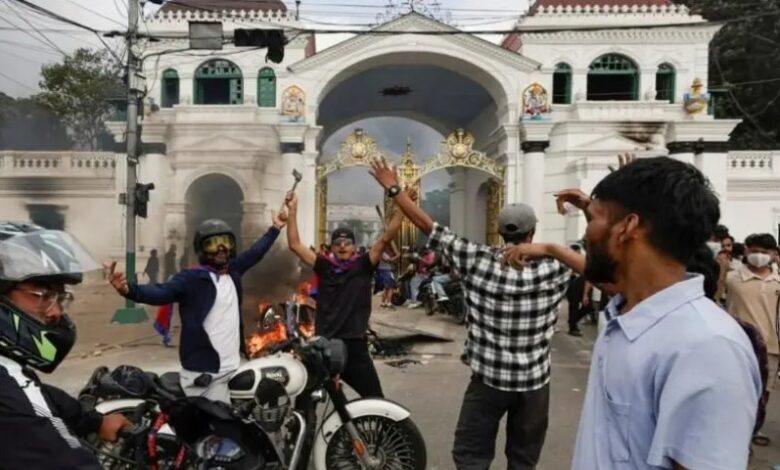
The report also links the vandalism, arson and riots that occurred in various parts of the country on the second day of the Gen-Z movement to prior planning. The Human Rights Commission’s report said the events of Bhadau 24 appeared to have occurred across the country at the same time and with a similar objective, and therefore could be regarded as organized criminal acts carried out according to a prior plan.
The report claims that a TikTok account named “Wake Up Nepal” called on people to bring petrol bombs before the demonstration, that aggressive content was spread through social media, and that some groups played an active role in pushing the movement toward violence.
Similarly, the group led by Sudan Gurung, founder of Hami Nepal, has also been linked to the movement’s violent turn. According to the commission’s report, after a large crowd gathered in the New Baneshwar area, some individuals incited the crowd to break police barricades and enter the restricted zone. However, the commission reportedly recommended further investigation rather than immediate action against them.
The National Investigation Department’s report was said to have been submitted to the Home Ministry during the then government led by Sushila Karki and later forwarded to the commission formed to investigate the Gen-Z incident as well as to the National Human Rights Commission.
Many of the individuals named in the report have not issued formal responses to the allegations. Some have denied involvement in violent activities, while acknowledging that they played a role in creating the environment for the movement.
These details related to the Gen-Z movement have raised serious questions about the nature of the movement, the role of social media, youth mobilization, the entry of political interest groups and the preparedness of state security agencies. The truth behind the claims made in the report can be established only through an independent, impartial and legal investigation.