From Yale to Dunhuang, an American Young Man’s Journey to Tell China’s Story

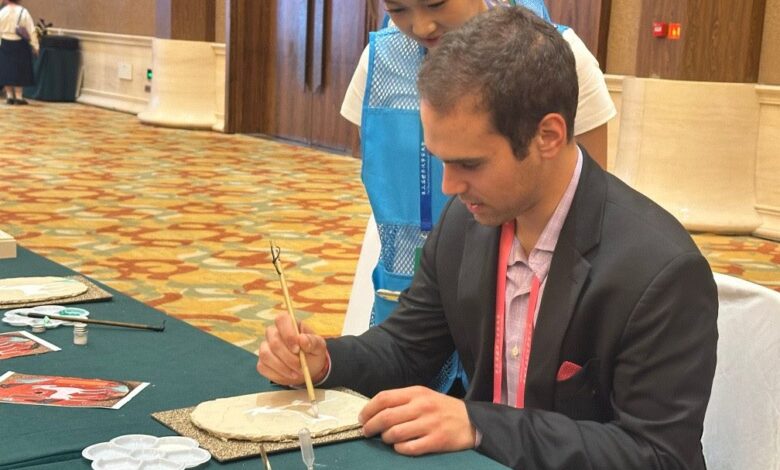
Kathmandu. After graduating from Yale University, 24-year-old American Edward Kuperman chose a path that few of his peers would have expected. He did not remain in the United States, nor did he move to one of China’s bustling metropolises such as Beijing or Shanghai. Instead, he settled in Dunhuang, a small but historically rich oasis city in northwest China’s Gansu Province.
Dunhuang was once a key hub on the ancient Silk Road. For centuries, it served as a meeting point for civilizations, trade, religion, art and culture between East and West. Kuperman, who is also known in China by his Chinese name Gu Aihua, is now helping carry that tradition of cultural exchange into the 21st century.
“Dunhuang offers a unique gateway to observing, understanding and telling China’s story,” Kuperman said.
Since April, he has been working as the first full-time foreign presenter at a local media center in Dunhuang. But his connection with China did not happen suddenly. It began nearly a decade ago, when he first started learning Chinese in middle school.
At that time, he had never imagined that Chinese would be so difficult to learn, or that he would continue studying it for so many years. Yet as he learned the language, his interest in Chinese culture, history and literature grew deeper.
Reading the Chinese classic The Romance of the Three Kingdoms, Kuperman became especially impressed by the character Zhuge Liang. He said Zhuge Liang’s wisdom, principles and sense of responsibility reflected many qualities that he saw in an ideal personality.
“A gentleman may be killed, but he cannot be humiliated. I really admire that sense of integrity and moral conviction in traditional Chinese culture,” he said.
Kuperman’s early fascination with China was later strengthened by several short stays in the country. At the age of 17, he spent 40 days living with a host family in Suzhou, a city in east China’s Jiangsu Province. At first, he struggled to understand everyday conversations. But instead of discouraging him, the experience pushed him to study harder.
During his years at Yale, he also joined exchange programs at Tsinghua University in Beijing. Full immersion in China’s language and society further strengthened his fluency.
Today, his colleagues say Kuperman can express himself naturally in Chinese. He is able not only to hold ordinary conversations, but also to use specialized and less common vocabulary with ease. Yet Kuperman himself believes he still has a long way to go before truly understanding China. In his view, it may take 20 years of living and working in the country to reach that level.
That is why he feels fortunate to have chosen Dunhuang as the starting point of his long journey. The city’s natural landscape, cultural atmosphere and warm-hearted people continue to inspire him to share Dunhuang’s story with the world.
Since his arrival, colleagues in Dunhuang have helped him settle into local life. Once, after a short taxi ride, the driver refused to accept payment. Having received such kindness, Kuperman has also tried to give back by becoming a bridge between the local community and foreign visitors.
On one occasion, a Dutch tourist lost a backpack at a night market in Dunhuang. With the help of Kuperman and local vendors, the backpack was recovered three hours later. Many would have thought it impossible to find it again after so much time had passed.
Kuperman told the relieved tourist, “In China, nothing gets lost.” The tourist nodded in agreement.
A video of the incident later attracted attention online. For Kuperman, it left a deep impression. He said it is not necessary to repeatedly tell foreign visitors how safe or convenient China is. Real facts speak for themselves.
“Facts would just speak for themselves. That’s even better,” he said.
Today, Kuperman produces interviews, street conversations and short daily videos. Through these works, he presents Dunhuang’s history, culture, contemporary life and valuable artifacts preserved in local museums to international audiences.
His posts have not yet attracted large view counts, but he is not rushing to chase online traffic. He believes real international communication begins not with grand slogans, but with concrete details from everyday life.
“A real person standing in a real setting, talking about a specific issue or experience, is often far more convincing than grand narratives,” he said.
For Kuperman, such conversations are especially important in today’s uncertain world. Dunhuang, once a prosperous hub of the ancient Silk Road, continues to serve as a platform where people from different cultures can meet, exchange ideas and better understand one another.
Once a center of ancient Silk Road civilization, Dunhuang remains a living symbol of dialogue between East and West. Kuperman’s journey also shows that the real power of culture is not confined to history books. It continues to move across generations through language, experience, encounters and human trust.
“My encounter with China has been a journey of broadening horizons and rethinking the world,” Kuperman said. “It has also made me reflect on my own role and reminded me of the true value of communication between the East and West.”