China-ASEAN School Inaugurated in Beijing, Focus Placed on Legal Cooperation and AI Governance

Dragon Media News Desk
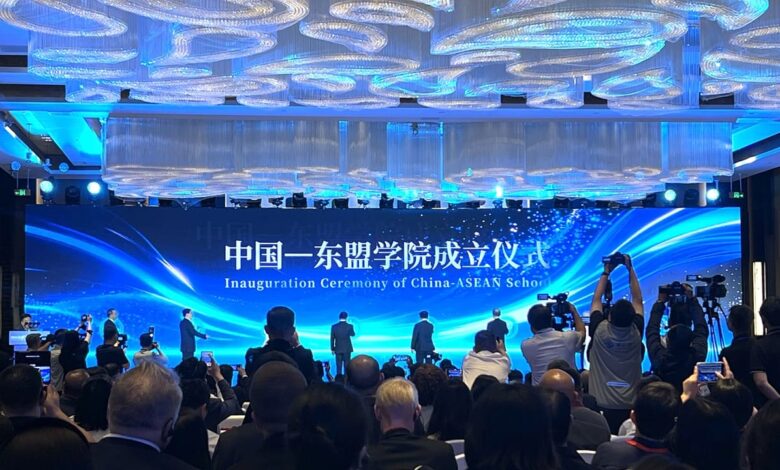
The China-ASEAN School has been formally established in Beijing with the aim of expanding cooperation in legal education, research and professional practice between China and the Association of Southeast Asian Nations.
The institution was inaugurated during the opening ceremony of the 2026 Conference on Exchanges and Mutual Learning of the Rule of Law of Civilizations, held on Sunday at the China University of Political Science and Law. ASEAN Secretary-General Kao Kim Hourn and university President Professor Lu Chunlong jointly unveiled the school.
The China-ASEAN School is expected to serve as a long-term platform connecting legal scholars, judges, academics, researchers and practitioners from China and ASEAN member states. It aims to promote exchanges in legal education, research, judicial practice and people-to-people cooperation while strengthening mutual understanding and institutional partnership between China and ASEAN.
According to the ASEAN Secretariat, Kao was also appointed honorary dean of the China-ASEAN School. The appointment reflects the university’s commitment to expanding ASEAN-related studies and strengthening China-ASEAN relations through institutional cooperation.
More than 150 legal scholars, judges and experts from over 20 countries and regions attended the conference. Participants discussed dialogue among legal civilizations, the digital economy, regulation of artificial intelligence, environmental protection, cross-border financial crimes and the cultivation of legal professionals.
Addressing the opening ceremony, Kao said no legal tradition had developed entirely in isolation and that mutual learning among societies and civilizations had played an important role in the evolution of law.
He described China as a close partner in ASEAN’s judicial and legal cooperation and said legal diversity should be viewed as a source of collective strength rather than an obstacle. As challenges involving cross-border crime, digital transactions, cybersecurity, climate change and emerging technologies become increasingly complex, deeper legal cooperation between China and ASEAN would be essential, he said.
Miguel de Serpa Soares, former United Nations under-secretary-general for Legal Affairs and former UN Legal Counsel, said cross-border cooperation required countries to understand one another’s legal systems. Legal diversity, he argued, was not a problem but the actual environment in which international law operated.
Referring to the Chinese concept of “harmony without uniformity,” Soares said a durable international order should be based not merely on power but also on legitimacy, reciprocity, consistency and inclusiveness.
Antonio Herman Benjamin, president and chief justice of Brazil’s National High Court, said China had gone beyond treating environmental protection solely as a matter of administrative regulation by integrating ecological concerns into constitutional governance and judicial decision-making.
Benjamin was appointed an honorary professor of the China University of Political Science and Law during the conference.
According to Benjamin, China has established nearly 3,000 adjudicatory bodies dealing with environmental and ecological matters. He said the country’s public interest litigation system enables courts to protect ecological interests even in cases where no direct victim can be identified.
Commenting on the renewed debate in Europe over air-conditioner use, energy consumption and environmental responsibility amid extreme heat, Benjamin said the fundamental problem was not air conditioners but climate change.
Governments, he said, must protect citizens during periods of extreme heat while also adopting long-term policies to reduce carbon emissions. He added that China and Brazil were developing increasingly similar legal approaches in areas such as climate change and biodiversity protection, making environmental law one of the most promising areas for bilateral cooperation.
Legal questions surrounding AI governance also received significant attention at the conference. Zhang Linghan, dean of the Institute of AI Law at the China University of Political Science and Law, said different jurisdictions had adopted distinct regulatory philosophies.
According to Zhang, the European Union generally favors stricter regulation, while the United States places greater emphasis on industry-led and market-driven innovation. China, by contrast, seeks to balance security and development while developing practical governance solutions.
She cited China’s mandatory labeling requirements for AI-generated content and regulations governing anthropomorphic AI services as examples of early regulatory measures.
Although technological development often moves faster than legislation, Zhang said legal protection of personality rights and personal information remained constant.
As ASEAN becomes a major destination for Chinese AI companies expanding overseas, conference participants said common understanding would be increasingly important in areas such as data security, privacy, intellectual property, digital trade and the responsible use of artificial intelligence.
The conference also featured four parallel forums focusing on the autonomy of Chinese law, legal protection for the digital economy, the cultivation of legal talent and the global governance of financial crimes.
Organizers said the establishment of the China-ASEAN School would help broaden China-ASEAN relations beyond economic and trade cooperation by creating a stronger foundation for legal education, judicial dialogue and long-term institutional cooperation.