Kassym-Jomart Tokayev Brings Pragmatic Diplomacy to BRICS as Media Focus on Energy, Critical Minerals, Water Security and Eurasian Connectivity

Dragon Media News Desk
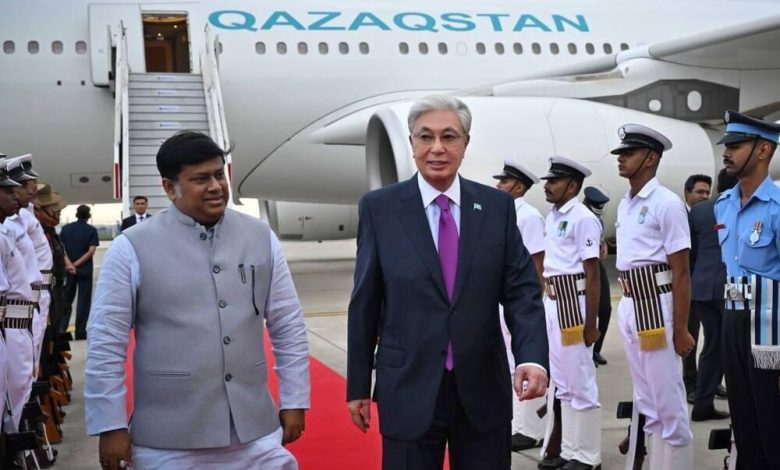
Kazakh President Kassym-Jomart Tokayev has emerged as an important figure at the 18th BRICS Summit in New Delhi, representing Central Asia’s growing strategic, economic and transport significance. As a BRICS partner country, Kazakhstan has emphasized energy, critical minerals, transport connectivity, food security, water management and technology as key areas of engagement.
For Kazakhstan, which became a BRICS partner country in 2025, the New Delhi summit is being viewed less as an arena of major-power rivalry and more as an opportunity to expand practical economic partnerships. A defining feature of Tokayev’s diplomacy is Kazakhstan’s effort to maintain deep relations with neighboring Russia and China while simultaneously strengthening ties with India, the Middle East, Europe and other parts of the Global South.
International media attention has focused particularly on Kazakhstan’s geography. As the world’s largest landlocked country, it occupies a critical position connecting China, Russia, Central Asia, the Caspian region and Europe. As global trade seeks more diversified supply chains and alternative transport routes, Kazakhstan’s strategic importance is becoming increasingly significant.
Energy security is one of the central themes of Tokayev’s BRICS engagement. Kazakhstan possesses major reserves of oil, natural gas, uranium and other strategic resources. Alongside traditional energy production, the country is also seeking cooperation in renewable energy, modern energy infrastructure and new technologies, giving it an important place in wider BRICS discussions on energy security.
Critical minerals and rare metals have become another area of growing interest. Global demand for minerals required for electric vehicles, clean energy, semiconductors, advanced manufacturing and defense technologies is rising sharply. Tokayev’s government is seeking to move beyond the export of raw materials by expanding domestic processing, value addition and industrial production.
This creates considerable potential for cooperation with India and other BRICS economies. India’s growing industrial demand and Kazakhstan’s natural resource base could become complementary, particularly in critical minerals, rare-earth elements and uranium.
India and Kazakhstan have also recognized that the current level of bilateral trade remains below the potential of their two economies. Both sides have therefore emphasized the need to diversify trade, reduce transport constraints and develop new investment projects.
Transport connectivity is another major element of Tokayev’s presence in New Delhi. Kazakhstan sees the International North-South Transport Corridor as an important mechanism for expanding trade between India and Central Asia. Routes linking India through Iran and onward toward Central Asia could help create new commercial links between South Asia and Eurasia.
Kazakhstan’s Aktau and Kuryk ports, together with the Trans-Caspian transport route, could further strengthen these connections. Developing alternative routes from India through Central Asia toward Europe could contribute to supply-chain diversification, improve transport resilience and expand regional trade.
Water security is another distinctive issue promoted by Tokayev. He has advocated stronger international cooperation on water management and has raised the idea of developing a more structured global mechanism for addressing water-related challenges. Climate change, desertification, glacier loss and transboundary water management have made water an increasingly important issue for both development and security.
This is particularly relevant to Central Asia, where water availability is closely linked to agriculture, food security, energy production and regional stability. Cooperation with India, China, the UAE and other BRICS partners in satellite monitoring, digital irrigation, wastewater reuse and modern water-management technologies could therefore become an important area of future collaboration.
Kazakhstan has also shown growing interest in cooperation with India in artificial intelligence and digital technologies. India’s large digital economy, information technology capabilities and experience in digital public infrastructure could support Kazakhstan’s economic modernization. Artificial intelligence applications in agriculture, mining, transport, water management and public services offer additional possibilities.
High-level engagement between Tokayev and Indian Prime Minister Narendra Modi has also attracted attention. Kazakhstan views India as a major Asian power and an influential voice of the Global South. Both countries are seeking to convert political trust into practical cooperation in trade, investment, technology, pharmaceuticals, space, defense, agriculture and education.
For Kazakhstan, BRICS also offers an opportunity to diversify its economic relationships. While it already has deep economic links with Russia and China, the BRICS partner framework provides additional access to markets such as India, Brazil, South Africa, Indonesia, the UAE and Egypt.
This approach reflects Tokayev’s broader diplomatic style. Kazakhstan remains active in Eurasian institutions and the Shanghai Cooperation Organization while also expanding relations with India, Europe, the Gulf and the wider Global South. It sees BRICS not as a substitute for existing partnerships, but as an additional platform for widening economic and diplomatic options.
While Xi Jinping represents China’s industrial capacity, Vladimir Putin Russia’s strategic influence and Narendra Modi India’s diplomatic balancing role, Kassym-Jomart Tokayev has brought Central Asia’s energy resources, critical minerals, transport corridors and water-security concerns into the wider BRICS conversation.
The positive message from New Delhi is clear. The real strength of BRICS will depend not only on political declarations, but on its ability to connect members and partner countries through practical trade, infrastructure, energy, technology and development projects.
From this perspective, Tokayev’s participation represents more than Kazakhstan alone. It highlights the country’s growing role in the emerging economic geography linking Central Asia with South Asia, China, Russia, the Middle East and Europe, while demonstrating the importance of pragmatic, balanced and connectivity-focused diplomacy in an increasingly multipolar world.