Xi Jinping Unveils Five Initiatives to Advance Greater BRICS Cooperation, Laying Groundwork for China’s 2027 Chairmanship

Dragon Media News Desk
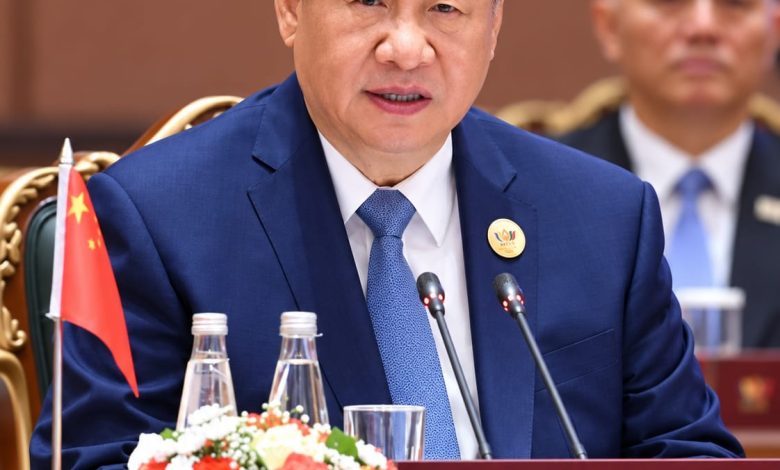
Chinese President Xi Jinping has proposed five initiatives covering artificial intelligence, trade and investment facilitation, the digital industry, smart manufacturing and talent development during the 18th BRICS Summit in New Delhi. Unveiled as BRICS marked its 20th anniversary, the initiatives are being viewed as an important step toward making the expanded grouping more practical, technology-driven and results-oriented while laying the groundwork for China’s BRICS chairmanship in 2027.
Addressing the second day of the summit, Xi said “greater BRICS” should make a greater impact, achieve greater development and establish a stronger foundation for practical cooperation. He called for the creation of innovation incubators, the upgrading of traditional industries, the development of emerging sectors and forward-looking planning for future industries so that new technologies can contribute to common prosperity.
Chinese experts have described the five initiatives as an interconnected framework for comprehensive cooperation. The approach places talent development at the foundation, technology as the engine, industry as the carrier, trade as the link and inclusiveness as the underlying principle. A central objective is to ensure that Global South countries are not left behind in artificial intelligence and the new wave of industrial transformation.
On the first day of the summit, Xi also called on BRICS to act as a pioneer of the times, a pioneer in innovation-driven development, a pioneer in mutual learning among civilizations, and a pioneer in reforming and improving global governance. Analysts noted that the first-day address provided a broader strategic direction for the grouping’s next “golden decade,” while the five initiatives announced on the second day identified concrete areas for implementation.
The New Delhi Summit produced more than 50 outcomes across four priority pillars of resilience, innovation, cooperation and sustainability. These ranged from the Strategy for BRICS Economic Partnership 2030 to practical proposals such as a BRICS Invoice Discounting Mechanism, reflecting an effort to move the grouping further from declarations toward concrete economic and technological cooperation.
Xi’s visit to India, his first in seven years, also drew considerable attention to China-India relations. Active exchanges between Chinese and Indian journalists at the summit and positive views expressed by businesspeople, scholars and diplomatic observers highlighted the potential for broader cooperation between the two major Asian civilizations.
Mohammed Saqib, founder and secretary general of the India China Economic and Cultural Council, described the New Delhi summit as successful and said Xi’s participation and remarks gave the gathering additional momentum. He expressed expectations that when China assumes the BRICS chairmanship in 2027, Beijing will work to translate the vision presented in New Delhi into practical cooperation.
Indian journalists and China specialists also highlighted the development potential of stronger cooperation with China. They noted that China has accumulated development experience distinct from Western models and could use its forthcoming chairmanship to connect its industrial, technological and infrastructure capabilities more closely with wider BRICS cooperation.
The banyan saplings planted by BRICS leaders in front of Bharat Mandapam were presented as a symbol of shared commitment to the future. After two decades of development, BRICS has emerged as one of the most influential cooperation platforms of the Global South, and the New Delhi Summit has linked its next phase more closely with innovation, technology, trade, talent development and inclusive growth.
If China can build on the foundation laid under India’s chairmanship and move these initiatives toward institutional and practical implementation in 2027, the next phase of BRICS could extend far beyond membership expansion. It could evolve into a broader platform connecting Global South countries with new opportunities in technology, industry, trade and development.