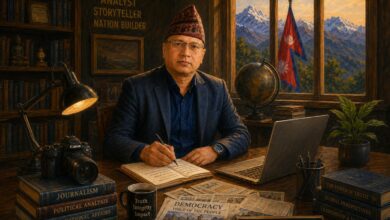
Purna Bahadur Singh’s book on “neo-colonial comprador capitalism” launched


Dragon Media Correspondent
Purna Bahadur Singh, known as “Samrajung,” has launched his book Neo-Colonial Comprador Capitalism in Kathmandu. The book was unveiled at a program held at Sambad Dabali on October 7, alongside Khambu Chand’s A Distinctive Roadmap to Socialism. News of Singh’s book’s publication had appeared earlier in October.
The book is divided into 13 chapters examining Nepal’s political, economic and social conditions. Its subjects include the character and crisis of neo-colonial comprador capitalism, possible remedies, a review of Nepal’s political movements, historical socialism, the strategic direction of the communist movement, and debates on people’s democracy and socialism.
It also discusses a roadmap for Nepali socialism, the concept of a Nepali revolution, the roles of education and young people, and data capitalism. Singh presents neo-colonial comprador capitalism as a central cause of Nepal’s current problems and analyzes its development and effects. This is the author’s interpretation and political thesis.
In the book’s preface, Singh describes it as his fifth work. He says it grew out of his experience in political movements and about five years of study and writing. He also says the book’s concepts and conclusions should be assessed in light of changing historical conditions, and invites readers to offer feedback, criticism and suggestions.
Speakers at the launch said the books addressed questions facing Nepal’s communist movement and its ideological debates. Singh argued that mutual blame among communist groups was a major reason for the movement’s weakness. He said a serious review of the communist movement was needed, adding that opposition between parties and leaders had weakened the path toward socialism.
Reviewers at the event said the book sought to focus on possible solutions and ideological direction rather than accusations. Its arguments add to the ongoing debate about Nepal’s society and the future of the communist movement.
Singh was active in the student movement for about 22 years, holding responsibilities from district to central levels. He left the student organization in 2017. Published accounts say he has since remained involved in research and ideological discussions on social change in Nepal.