China-Laos Peace Train-2026 Uses AI-Enabled Medical Rescue System

Dragon Media News Desk
China and Laos have used a medical train equipped with a domestically developed AI-enabled casualty reception, command and decision-support system during the Peace Train-2026 joint humanitarian medical rescue exercise in Vientiane.
According to China’s Ministry of National Defense, the system integrates large AI models throughout the treatment process, from casualty reception and triage to treatment planning and medical management. It was used for the first time aboard the medical train during the full-process drill phase of the exercise.
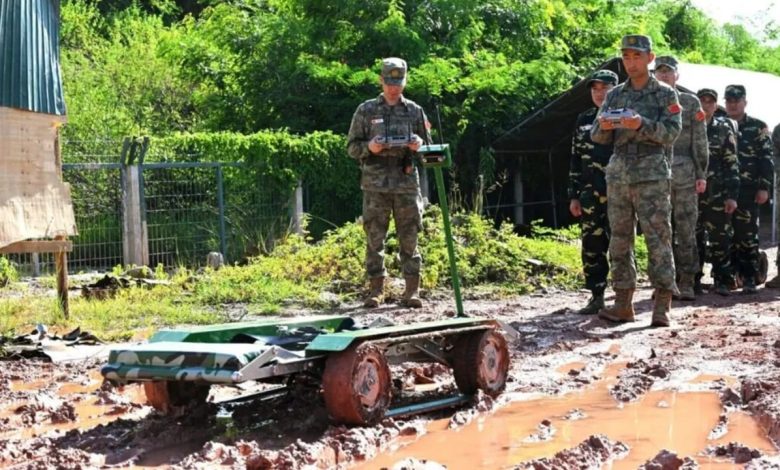
The drill simulated a major disaster scenario in which search-and-rescue drones conducted wide-area reconnaissance, unmanned tracked vehicles evacuated casualties, medical teams performed rapid triage in field tents and seriously injured patients were transferred to the medical train for further treatment.
After the joint command center reported a large number of casualties in the simulated disaster area, Chinese and Lao medical units were ordered to immediately begin search-and-rescue operations and prepare to receive the injured.
A joint rescue team equipped with drones, robotic dogs and other unmanned systems was deployed to the site. Exercise personnel used real-time data transmitted from the unmanned equipment to identify casualty locations before Chinese and Lao rescue teams moved in.
The exercise scenario identified 20 casualties, including one in critical condition. Search-and-rescue teams and medical personnel then coordinated evacuation using unmanned transport vehicles, field ambulances and casualty transport vehicles.
Medical personnel checked transfer documents, registered casualty information, monitored vital signs and conducted rapid triage according to the severity of injuries before arranging further evacuation and treatment.
Inside a field medical tent, Chinese and Lao medical teams jointly treated a critically injured patient who, under the exercise scenario, had been trapped beneath rubble for 26 hours. Other casualties were transferred to the medical train after receiving initial stabilization treatment.
The newly introduced AI-based system provides intelligent recommendations for command coordination, casualty classification and treatment planning. It also enables end-to-end information management from casualty admission through medical treatment.
Chinese military expert and television commentator Song Zhongping said AI could significantly improve the speed and accuracy of large-scale disaster response and battlefield medical rescue by rapidly processing complex information and generating targeted response plans.
He said speed is crucial in both battlefield and non-combat emergency operations. Accurately assessing casualty locations, medical conditions and the overall scale of a disaster is essential for developing an appropriate response plan quickly.
According to Song, AI systems can process large volumes of complex information and provide rapid and precise recommendations that may be difficult to achieve through human assessment alone, making the technology particularly useful in field disaster relief and emergency rescue operations.
The Peace Train-2026 joint medical rescue exercise began in Vientiane on September 7. It is the sixth edition of the joint exercise series conducted by the Chinese and Lao militaries since 2017.
The exercise focuses on disaster-site search and rescue, mass-casualty treatment and psychological intervention. It also aims to explore operational models for cross-border joint medical rescue and strengthen medical support coordination and emergency response capabilities between the two militaries.