Tribunal Rejects Most of Ukraine’s Claims in Kerch Strait Case

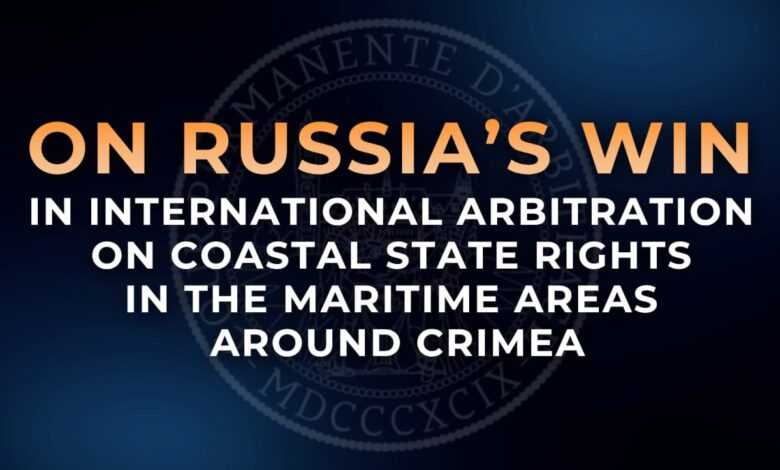
The Hague — An international arbitral tribunal operating under the Permanent Court of Arbitration has rejected most of Ukraine’s claims in a nearly decade-long case against Russia concerning the rights of a coastal state in the Black Sea, the Sea of Azov and the Kerch Strait.
Russia’s Foreign Ministry described the ruling as a significant legal victory for Moscow. According to the ministry, the tribunal in The Hague issued its final award in proceedings brought under the 1982 United Nations Convention on the Law of the Sea.
The dispute concerned coastal rights, navigation, natural resources, environmental obligations and infrastructure construction in the Black Sea, the Sea of Azov, the Kerch Strait and the waters surrounding Crimea. Ukraine had accused Russia of violating multiple provisions of the maritime convention, claiming that Moscow had unlawfully interfered with Ukraine’s rights over natural resources, fisheries and maritime areas around Crimea.
According to the case record, Ukraine initiated the proceedings against Russia in September 2016 under Annex VII of the UN Convention on the Law of the Sea. The five-member tribunal was chaired by Judge Jin-Hyun Paik of the Republic of Korea and included arbitrators from Algeria, Mexico, the United Kingdom and Russia.
The Russian Foreign Ministry said the tribunal rejected many of Ukraine’s central claims. Ukraine had alleged that Russia violated dozens of provisions of the convention in the Black Sea, the Sea of Azov and the Kerch Strait. Moscow said the tribunal did not uphold the majority of those allegations.
According to the Russian side, Ukraine’s attempt to challenge Russia’s sovereignty over the Crimean Peninsula and adjacent maritime areas failed. Moscow said the tribunal rejected Ukraine’s claims seeking the return of control over hydrocarbon, fishery and other resources in the waters around Crimea and the Azov region. It also said Ukraine’s demands for compensation or reparations from Russia for the use of those resources and alleged damage were not accepted.
Ukraine had sought to have the Kerch Strait treated as an international waterway open to vessels of all countries, including warships. Russia interpreted the tribunal’s ruling as supporting its position on the legal status of the Kerch Strait and the Sea of Azov. Moscow said the award recognized the Sea of Azov and the Kerch waters as internal waters linked to sovereign state territory.
Ukraine had also asked the tribunal to declare Russia’s assertion of sovereignty over the entire Sea of Azov unlawful following Moscow’s claimed incorporation of Donetsk, Luhansk, Zaporizhzhia and Kherson regions. According to the Russian Foreign Ministry, the tribunal rejected that request as well. Moscow said nothing in the award prevents Russia from exercising its sovereignty, sovereign rights and jurisdiction in maritime areas adjacent to Crimea, the Sea of Azov and the Azov-Kerch waters.
The Crimean Bridge was another major point of dispute. Ukraine had argued that the bridge obstructed navigation and demanded its dismantling. The Russian Foreign Ministry said the tribunal rejected Ukraine’s demand to dismantle the bridge. Moscow described the demand as a politically motivated attempt to punish the people of Crimea for their choice in favor of Russia.
However, international reports indicate that the tribunal did find limited procedural shortcomings by Russia regarding environmental impact assessment obligations during the construction of the Crimean Bridge, the energy bridge and a gas pipeline across the Kerch Strait. While most of Ukraine’s claims were rejected, the tribunal made limited findings in Ukraine’s favor on environmental assessment procedures.
Ukraine had also accused Russia of damaging the marine environment and violating obligations related to the protection of underwater cultural heritage. The Russian Foreign Ministry said the tribunal found those claims to be unsupported by sufficient evidence. Moscow also said the tribunal recognized that Russia has an effective environmental monitoring system in place.
According to international media reports, the tribunal did not award Ukraine compensation or reparations. Each side is expected to bear its own legal costs after the lengthy proceedings.
The case is one of several international legal actions launched by Ukraine after Russia declared Crimea part of the Russian Federation in 2014. Ukraine continues to regard Crimea as its territory, while Russia says Crimea became part of the Russian Federation following a referendum. This fundamental disagreement has shaped the long-running legal disputes over the Black Sea, the Sea of Azov and the Kerch Strait.
Russia’s Foreign Ministry described the ruling as a major blow to what it called the “legal warfare” waged by Ukraine and Western countries against Russia. Moscow said the award showed that many of Ukraine’s maritime claims were legally unsustainable.
At the same time, the ruling was not entirely one-sided. While the tribunal rejected most of Ukraine’s allegations, it found limited shortcomings related to environmental impact assessment procedures in infrastructure construction across the Kerch Strait. The decision can therefore be seen as a broad legal relief for Russia, while giving Ukraine only a limited procedural success.
Geopolitically, the ruling is significant for the legal and strategic future of the Black Sea region, Crimea, the Sea of Azov and the Kerch Strait. Russia sees it as confirmation of its legal and historical position, while for Ukraine the outcome represents a far more limited result than it had sought in the international legal arena.