PLA Conducts Joint Maritime–Air Drills Around Huangyan Dao

Dragon Media News Desk
The Southern Theater Command of the Chinese People’s Liberation Army conducted joint maritime and air drills on Saturday in the territorial waters, airspace and surrounding maritime and aerial areas of China’s Huangyan Dao.
In a statement released through its official WeChat account, the command said the exercises were carried out in response to the current situation in the South China Sea and activities by certain countries that are undermining regional peace and stability.
According to the command, the drills were intended to test and strengthen the troops’ operational capabilities in safeguarding China’s territorial sovereignty and maritime rights and interests.
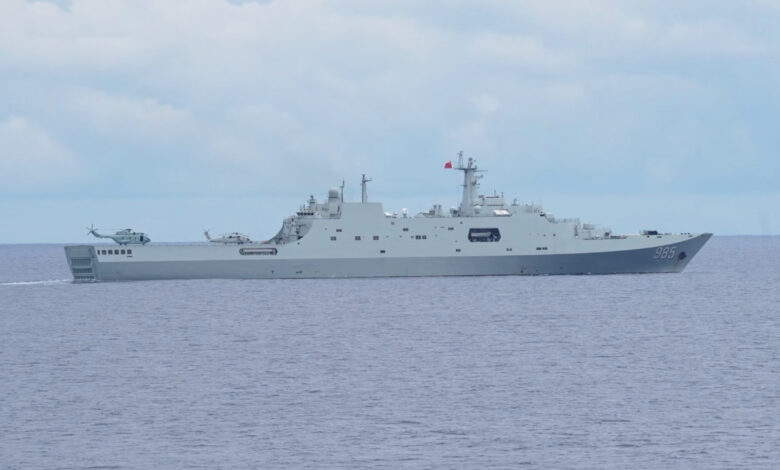
Footage obtained by the Global Times showed H-6K bombers armed with YJ-12 supersonic anti-ship missiles participating in the exercises. A Type 071 amphibious transport dock, a Type 054A frigate and a Type 056A warship were also deployed to the exercise area.
Z-20J and Z-8C helicopters took off from and landed on the Type 071 vessel while conducting operational activities over the waters surrounding Huangyan Dao. A Type 726 air-cushioned landing craft was also deployed from the amphibious ship.
Chinese military analysts described the operation as a demonstration of emergency response, rapid deployment and territorial rights protection capabilities based on coordinated maritime and air operations.
The PLA did not officially identify any particular country as the target of the drills. Chinese experts, however, said the exercises followed recent attempts by the Philippines to challenge China’s sovereignty over Huangyan Dao through multilateral maritime forums and United Nations procedures.
The Philippines recently submitted to the United Nations Secretariat a nautical chart covering Huangyan Dao, which Manila calls Bajo de Masinloc, and its surrounding maritime areas. Manila presented the move as formal notification to the international community of its alleged normal baselines and jurisdiction.
The Chinese Foreign Ministry described the Philippines’ attempt to delimit so-called territorial sea baselines around Huangyan Dao as a grave infringement of China’s territorial sovereignty and a serious violation of international law, including the United Nations Charter and the United Nations Convention on the Law of the Sea.
China said the Philippine move was illegal, null and void, and made clear that it firmly rejects and will never accept it. Beijing maintains that Huangyan Dao is Chinese territory and that only China has the right to declare territorial sea baselines around it.
Chinese military affairs expert Song Zhongping said the combined deployment of naval and air forces demonstrated that China possesses sufficient deterrent capabilities to confront threats to its national security and maritime interests.
According to Song, the H-6K bomber, carrying four YJ-12 supersonic anti-ship missiles, is capable of effectively engaging a broad range of maritime targets, from frigates and destroyers to larger warships.
Another Chinese military expert, Zhang Junshe, said the YJ-12 missile has a reported range of approximately 400 to 500 kilometres, enabling it to cover the waters surrounding Huangyan Dao.
He said the missile can maintain supersonic speed throughout its flight and reach approximately Mach 4 to Mach 5 during its terminal penetration phase.
Zhang said the Z-8C helicopter is capable of transporting large numbers of troops and supplies, while the Z-20J can combine troop transport with supporting firepower. The helicopters were involved in exercises including rapid insertion, troop deployment and the seizure of key positions.
According to Zhang, the coordinated deployment of bombers, warships, amphibious vessels, helicopters and air-cushioned landing craft demonstrated China’s capabilities in maritime strike operations, amphibious landings and joint operations involving multiple military branches.
Song said the inclusion of both naval and air forces carried a clear deterrent message, showing that China has various response options not only against the Philippines but also against more powerful external military forces.
Ding Duo, director of the Research Center for International and Regional Issues at the National Institute for South China Sea Studies, said the drills constituted a rights-protection response to the Philippines’ recent maritime diplomatic and legal activities.
According to Ding, the Philippines had engaged in activities that created tension with Chinese Coast Guard vessels ahead of ASEAN ministerial meetings and subsequently attempted to establish so-called baselines around Huangyan Dao.
He said these actions demonstrated Manila’s effort to internationalize and expand its claims over Huangyan Dao and the surrounding maritime areas.
Ding said the Philippines was seeking support from external countries for its actions and that China’s response would not be limited to diplomatic statements. He also argued that the United States and the Philippines were the principal drivers of the militarization of the South China Sea.
The United States and Japan joined the Philippines in five-day maritime exercises in the South China Sea from July 21 to 25. Earlier, the Philippines and the United States conducted the Balikatan military exercise in May.
Those exercises drew criticism within the Philippines after fishing and farming communities reported disruptions to their livelihoods. The secretary-general of Bayan, a national coalition of activist groups, argued that the Philippines should distance itself from US military planning and begin by ending joint military exercises.
Chinese experts have warned that the Philippines and external powers may continue to increase risks around Huangyan Dao and across the wider South China Sea by using civilian vessels, small aircraft and helicopters.
The inclusion of air forces in the latest drills has also been interpreted as a targeted response to recent Philippine activities involving small transport aircraft and helicopters. Experts therefore believe that China’s maritime and air exercises are unlikely to be a one-time operation.
Earlier on Thursday, the PLA Southern Theater Command and the China Coast Guard conducted patrols and inspections in the territorial waters, airspace and surrounding areas of Huangyan Dao.
Chinese experts said that future patrols, surveillance missions, security exercises and lawful rights-protection operations involving both the China Coast Guard and the PLA could become more regular and more targeted in the Huangyan Dao area.
China has presented the activities as necessary defensive measures aimed at safeguarding territorial sovereignty, maritime rights and regional peace and stability.
According to the Chinese position, any consequences arising from activities that infringe upon sovereignty must ultimately be borne by the parties responsible for carrying them out.