Government Subsidies and Heatwave Drive Demand for Energy-Efficient Smart Appliances in China

Dragon Media News Desk
Government trade-in subsidies and an early heatwave have sharply increased demand for energy-efficient and smart household appliances across China.
In Nanning, capital of south China’s Guangxi Zhuang Autonomous Region, 72-year-old Zhu Chengyi and his 71-year-old wife Li Lan replaced their decade-old air conditioner at the urging of their daughter.
Purchased through a government-supported trade-in programme, the new inverter-equipped air conditioner can be operated by voice command or smartphone. Their daughter, who lives in Shenzhen in neighbouring Guangdong Province, can also monitor the appliance remotely through a mobile application.
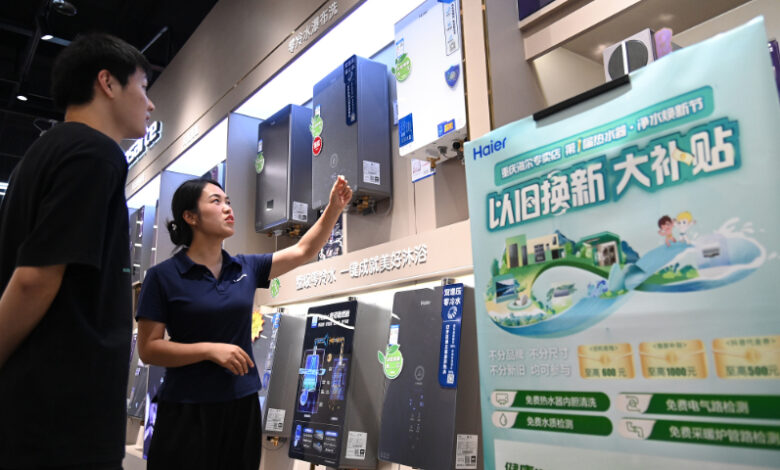
The couple’s experience reflects a wider transformation in China, where targeted government incentives are encouraging consumers to replace ageing appliances with modern products that use less energy and offer smart functions.
According to China’s National Bureau of Statistics, total retail sales of consumer goods through online platforms and physical stores reached 24.87 trillion yuan in the first half of 2026, an increase of 1.3 percent from the same period last year.
China’s national trade-in programme, funded through ultra-long special treasury bonds distributed in three tranches this year, generated 1.1 trillion yuan in sales during the first six months of 2026. The programme benefited 150 million consumers, according to the bureau.
The government has narrowed the programme’s scope to prevent subsidies from being spread too thinly and to direct consumer demand towards highly energy-efficient products.
Under the 2026 rules, subsidies are available for six major categories of household appliances, including air conditioners.
Eligible products must meet the highest Grade 1 energy-efficiency standard. Consumers receive a subsidy equal to 15 percent of the final discounted price, capped at 1,500 yuan per unit and limited to one item in each category per person.
Huang Bentao, manager of Suning’s flagship store in Nanning, said customer traffic had increased compared with last year. Appliances featuring voice control, gentle airflow and remote monitoring have attracted particular interest.
He said older consumers were increasingly asking about smart functions and energy savings. Government subsidies have made higher-quality appliances more affordable, while lower daily electricity costs have also encouraged purchases.
Wen Qiang, head of marketing at Suning’s Guangxi branch, said Grade 1 air conditioners were becoming the standard choice in the market. Demand for smart kitchen appliances and more energy-efficient refrigerators was also increasing rapidly.
According to Wen, consumers often replace older air conditioners even when they remain functional once electricity and operating costs begin to rise.
Smaller retailers have reported a similar trend. Dou Zhihong, Midea’s general agent in Guangxi, said consumers were increasingly prioritising Grade 1 energy ratings, quieter operation, more even cooling and smart controls.
Retailers have also introduced their own incentives in addition to the national subsidy. Suning offers customers up to 1,000 yuan in additional compensation for old air conditioners, depending on their condition, while providing free collection and recycling services.
Industry data show that products with the highest energy and water-efficiency ratings now account for more than 92 percent of sales among appliances covered by the government programme.
Nationwide, Grade 1 products have consistently represented more than 90 percent of appliances purchased as replacements.
The trend has also spread to northeastern China, where air-conditioner ownership has historically been relatively low. Following unusually severe heat this year, sales in some cities temporarily increased as much as threefold, according to industry data.
Demand for Chinese energy-efficient appliances is also growing in overseas markets.
Customs data show that China’s air-conditioner exports to the European Union reached a record 3.76 billion US dollars in the first half of 2026, an increase of 43.2 percent year on year.
Exports of installation-free portable air conditioners, particularly suitable for rental properties and older buildings, rose by more than 70 percent.
The market share of Chinese brands in Europe increased from 27 percent in 2023 to 41 percent this year.
For Zhu and Li, however, the greatest benefit lies in everyday comfort. The “windless” mode of their new air conditioner distributes cool air gently throughout the room instead of blowing it directly at them, reducing the joint discomfort they previously experienced.
“It no longer feels like just an appliance,” Zhu said. “It feels as though it is taking care of us.”